

POD order tracking automation is the process of using software integrations and AI tools to automatically update customers on their print-on-demand order status without any manual input. The global automated order management market reached nearly $1.66 billion in 2025, signaling that automation is no longer optional for scaling e-commerce operations. For print-on-demand businesses selling across Amazon, Etsy, and Shopify, the stakes are especially high. Manual tracking creates delays, errors, and a flood of “where is my order” (WISMO) inquiries that drain support teams. Automated order tracking solves all three problems at once, and this guide shows you exactly how to build it.
What tools does pod order tracking automation require?
Before configuring any workflow, you need the right stack in place. The core components fall into four categories: your e-commerce platform, an order management system (OMS), carrier API access, and a customer notification layer.
E-commerce platforms like Shopify and WooCommerce serve as the starting point. Shopify’s distributed order management approach synchronizes inventory and order data in real time, reducing overselling and missed status updates across multiple sales channels. WooCommerce supports similar integrations through plugins, though it requires more manual configuration.

Order management systems and fulfillment integrations sit between your storefront and your fulfillment providers. An OMS pulls orders from every channel, routes them to the correct print provider or warehouse, and pushes status updates back to the storefront. For print-on-demand businesses using DTF, DTG, or embroidery workflows, this layer is where production queue data connects to shipping data.
Shipping carrier APIs are what make real-time tracking possible. Integrating directly with carriers like UPS, FedEx, USPS, or DHL through their APIs allows your system to fetch live status events. Carrier webhook integrations automate status updates by removing manual tracking input while increasing delivery timeline accuracy.
Notification and AI chatbot platforms complete the stack. Tools like Palmate AI and similar AI chatbot platforms handle inbound WISMO queries instantly, while notification platforms send proactive SMS, email, and push alerts at key shipping milestones.
| Tool type | Function in tracking automation |
|---|---|
| E-commerce platform (Shopify, WooCommerce) | Order intake, storefront sync, customer data |
| Order management system (OMS) | Routes orders, syncs inventory, manages fulfillment |
| Carrier APIs (UPS, FedEx, USPS, DHL) | Real-time shipment status and webhook events |
| AI chatbot (Palmate AI) | Instant WISMO response across chat, email, SMS |
| Notification platform | Proactive alerts at dispatch, transit, and delivery |
How to set up pod order tracking automation step by step
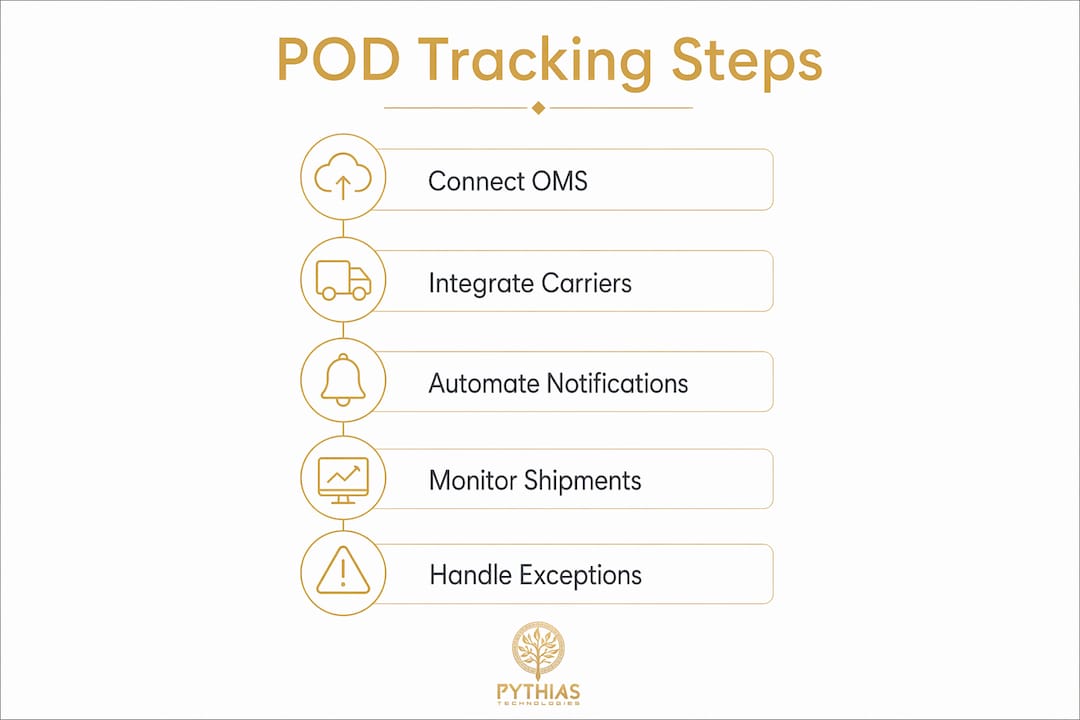
The setup process ranges from a 10-minute plug-and-play app install to a 6 to 12-week ERP integration, depending on your stack complexity. Deployment timelines vary based on whether you are connecting a single Shopify store or a multi-channel operation with custom fulfillment logic. Here is the practical sequence:
-
Connect your e-commerce platform to your OMS and fulfillment providers. Map every order source, whether that is Shopify, Etsy, or Amazon, to a single OMS. This eliminates the spreadsheet reconciliation that causes SKU mismatches and delayed fulfillment. Pythias Technologies supports multi-marketplace integration out of the box, connecting Amazon, Etsy, and Shopify to a unified production queue.
-
Integrate shipping carrier APIs for real-time status fetching. Request API credentials from each carrier you use. Configure webhooks so that every scan event (picked up, in transit, out for delivery, delivered) pushes automatically to your OMS and storefront. This removes the need for anyone to manually check carrier portals.
-
Implement an AI chatbot or self-service tracking portal. Once your tracking data flows in real time, connect it to a customer-facing layer. AI-powered order tracking delivers status in 5 to 15 seconds across any channel, eliminating hold times entirely. A self-service portal on your storefront handles the same function for customers who prefer not to use chat.
-
Configure proactive notifications for shipping milestones and exceptions. Set triggers for at least four events: order confirmed, shipped, out for delivery, and delivered. Add exception triggers for delays or failed delivery attempts. SMS notifications achieve a 98% open rate, making them the highest-priority channel for critical updates.
-
Test with live orders before full deployment. Run five to ten real orders through the full workflow. Verify that status updates appear on the storefront, that notifications fire at the correct triggers, and that the chatbot returns accurate data. Fix any gaps before scaling.
Pro Tip: Start with a Shopify app like AfterShip or Route for your first deployment. These tools connect to most major carriers in under 30 minutes and give you a working notification system while you build out deeper OMS integrations in parallel.
For a deeper look at how automated shipping manifests fit into this workflow, the Pythias Technologies blog covers the 2026 market context in detail.
Common challenges in order tracking automation and how to fix them
Even well-configured systems run into problems. Knowing the most common failure points before they happen saves hours of troubleshooting.
-
Delayed or missing carrier updates. Carrier APIs occasionally return stale data or drop webhook events during high-volume periods. The fix is to configure a polling fallback that checks carrier status every 30 to 60 minutes if no webhook fires within an expected window.
-
Split shipments and multi-package orders. Print-on-demand orders often ship in multiple packages from different production locations. Your OMS must generate a separate tracking record per package and link all records to the original order ID. Without this, customers receive incomplete tracking data and contact support anyway.
-
Data inconsistency between OMS and storefront. When inventory counts in your OMS do not match your storefront, overselling occurs. Shopify’s DOM approach eliminates manual spreadsheet errors by reconciling multi-channel inventory fast. Pair this with Pythias Technologies’ inventory management tools to keep stock counts accurate across every channel.
-
Delivery failures and exception handling. Successful automation systems handle exceptions intelligently by offering wait, escalate, and reship options rather than routing every failure to a human agent. Configure your chatbot to detect “delivery failed” events and present the customer with clear next steps automatically.
-
Customer expectations during production delays. Print-on-demand orders have a production phase before shipping. Customers who receive no update between order confirmation and shipment will contact support. Send a production-in-progress notification at the 24-hour mark to close this gap.
Pro Tip: Sync your garment printing shipping workflow with your OMS before connecting carrier APIs. Gaps in production-to-ship handoffs are the most common source of tracking delays in POD operations.
How automation transforms customer experience and support efficiency
The business case for order management automation is direct: automated tracking systems reduce support tickets substantially, easing the WISMO inquiry load. That is not a marginal improvement. It means a support team handling 500 tickets per week drops to roughly 100 tickets on the same order volume.
The benefits extend beyond ticket reduction:
- Response time drops from hours to seconds. AI agents handle order status queries in 5 to 15 seconds, compared to the 4 to 24-hour average response time for human agents on email queues.
- Proactive notifications shift customer sentiment. Proactive notification automation is the highest ROI activity in the tracking stack because it prevents inquiries before they form. A customer who receives a “your order shipped” SMS does not need to ask.
- Multi-channel coverage meets customers where they are. Effective order status updates automation covers email, SMS, live chat, and social messaging from a single integration layer. This matters for POD businesses selling across Etsy, Amazon, and Shopify simultaneously.
- Repeat purchase rates improve. Customers who receive accurate, timely updates report higher satisfaction and are more likely to reorder. The post-purchase experience is a direct input to lifetime customer value.
“AI agents first reach high accuracy with order tracking due to structured data, enabling rapid rollout and dependable responses.” — AI Genesis Blog
This accuracy advantage is why order tracking is the right place to start with AI customer service. The data is objective, structured, and verifiable. There is no ambiguity in a carrier scan event, which means AI responses are reliable from day one.
Key takeaways
POD order tracking automation reduces WISMO support tickets substantially and delivers customer status updates in seconds, making it the highest-ROI automation investment for print-on-demand businesses.
| Point | Details |
|---|---|
| Start with the right stack | Connect your OMS, carrier APIs, and notification platform before configuring any automation rules. |
| Deploy notifications first | SMS and email alerts at key milestones prevent the majority of inbound WISMO inquiries. |
| Handle exceptions automatically | Configure wait, escalate, and reship workflows so delivery failures do not require human intervention. |
| Fix data consistency early | Sync OMS and storefront inventory in real time to prevent overselling and tracking mismatches. |
| Use AI for instant responses | AI chatbots reach high accuracy on order tracking queries, making them reliable from the first week of deployment. |
Why order tracking is where automation should start
I have worked with enough e-commerce operations to know that most businesses try to automate the wrong thing first. They build complex product recommendation engines or loyalty program triggers before they have solved the most basic customer need: knowing where their order is.
Order tracking automation should always be the first automation project. The data is structured, the outcomes are measurable, and the ROI is visible within weeks. When a POD business cuts its WISMO ticket volume substantially, that is not an abstract efficiency gain. It is a specific number of hours returned to the support team every week, hours that can go toward handling real escalations or improving product quality.
The second thing I would push back on is the idea that automation replaces human service. It does not. It filters. The customers who reach a human agent after tracking automation is in place are the ones with genuinely complex problems: lost packages, incorrect items, production defects. Those conversations are higher value and easier to resolve because the agent has full order history and tracking data in front of them, not a queue of “where is my order” emails.
The third insight that most guides miss is that order tracking is the foundation for broader AI support. Once your AI agent handles tracking queries with high accuracy, you have proven the infrastructure. Expanding to return requests, reorder prompts, or product questions becomes a much smaller technical lift because the data pipeline already exists.
For POD businesses specifically, the real-time job status layer is what separates scalable operations from ones that plateau. Choose a platform that connects production queue data to shipping data in a single view. That connection is what makes every downstream automation reliable.
— Michael
Automate your POD order tracking with Pythias Technologies
Pythias Technologies is built specifically for print-on-demand businesses that need production and shipping data connected in one place.
The Pythias Technologies platform integrates directly with Amazon, Etsy, and Shopify, connecting your Brother GTX printers and fulfillment workflows to automated label generation and real-time inventory tracking. Pythias helps shops automate production and fulfillment so they can grow revenue and ship faster. Onboarding takes under two weeks, with dedicated support throughout setup. If you are ready to replace manual order management with a system that tracks, notifies, and reports automatically, explore the full platform features to see exactly what fits your workflow.
FAQ
What is POD order tracking automation?
POD order tracking automation is the use of software integrations, carrier APIs, and AI tools to automatically update customers on their print-on-demand order status without manual input. It covers everything from production queue updates to final delivery notifications.
How much does automated order tracking reduce support tickets?
Automated tracking systems reduce WISMO support tickets substantially. This frees support teams to focus on complex issues rather than routine status inquiries.
How long does it take to set up order tracking automation?
Setup time ranges from 10 minutes for plug-and-play Shopify apps to 6 to 12 weeks for full ERP or multi-channel integrations. Most POD businesses can have a working notification system live within one to two days using existing app marketplaces.
Which notification channel works best for shipping updates?
SMS is the most effective channel for critical shipping milestones, with a 98% open rate. Email covers broader order lifecycle updates, while AI chatbots handle real-time inbound queries across chat and social channels.
Can automation handle delivery failures without human agents?
Yes. Well-configured systems detect delivery failure events and present customers with automated options including waiting for redelivery, escalating to a support agent, or initiating a reship. This resolves the majority of delivery exceptions without any manual intervention.
Recommended
- The Role of Automated Shipping Manifests in 2026 | Pythias Technologies | Pythias Technologies
- DTG Printing Order Management for Print Shops in 2026 | Pythias Technologies | Pythias Technologies
- Optimize Your Garment Printing Shipping Workflow | Pythias Technologies | Pythias Technologies
- Why Real-Time Job Status Matters for Print on Demand | Pythias Technologies